
A waffle making club turns an after-school cooking session into a small, very edible production line. Students measure and mix batter, learn how much belongs in the iron, test toppings and flavor ideas, and discover quickly that a waffle does not need to look restaurant-perfect to disappear from a plate.
For schools, the appeal is simple: the equipment can be modest, jobs divide naturally among a group, and meetings can progress from basic technique to recipe experiments and student-led challenges.
Equipment You’ll Need
Plan on one or more electric waffle makers, mixing bowls, a whisk, measuring tools, a ladle or batter dispenser, heat-safe utensils, plates or trays, ingredients and cleaning supplies. A school kitchen or family and consumer sciences room may already have almost everything except the waffle irons, so reuse what is available before buying a miniature catering department.
One compact waffle maker is enough to test the idea, but it becomes the bottleneck with a larger group. Extra cooking stations improve the flow if the room’s electrical setup and school rules permit them. A batter dispenser reduces drips, while labeled storage bins stop small utensils from wandering off between meetings.
Suitable Locations
A teaching kitchen is easiest because it combines washable surfaces, sinks, refrigeration and suitable power. A cafeteria prep area may work if staff and school policy allow it. In a regular classroom, prioritize a hard floor, sturdy tables, a nearby handwashing sink and approved electrical outlets.
Place hot waffle makers on stable surfaces, route cords away from walkways, and keep toppings away from the hot-appliance zone. If several units will run at once, ask facilities staff what the room can support rather than finding out via a tripped circuit. Accessible prep space and roles such as measuring, mixing, timing and recipe recording also let students participate without everyone operating the iron.
Age Range
There is no universal school age for waffle making, so these are practical recommendations rather than official rules. In grades 3-5, students can measure, whisk and prepare toppings while an adult controls the waffle iron. Grades 6-8 can take responsibility for supervised cooking and station rotation. High school groups can scale recipes, compare techniques, calculate batch costs and lead more of the session.
Pre-measured ingredients and clearly assigned jobs simplify things for younger groups. Older students can tackle substitutions, savory waffles or recipe comparisons. The hot appliance remains the part to manage deliberately at every age.
Who Will Enjoy This?
This club suits students who like making things with a visible result, experimenting with flavors, working in small teams or turning precise instructions into something edible. Detail-minded members can own the measuring station; more inventive cooks may immediately start lobbying for cinnamon, fruit, cheese or a topping bracket.
It also gives a group room for friendly comparison without needing a formal competition. Crispness, topping design and recipe tweaks create plenty to discuss. The imperfect batch is rarely a total loss either. It usually has a second career as a snack.
Things to Consider
Food safety belongs in the routine from the start. The CDC’s raw flour and dough guidance warns against tasting uncooked batter because raw flour and raw eggs can carry harmful germs. Build handwashing, clean utensils and surfaces, thorough cooking and correct ingredient storage into setup and cleanup.
Allergens need equal attention. Waffles commonly involve wheat, egg and milk, while toppings can add peanuts, tree nuts, soy or sesame. Follow your school’s established procedures and use the CDC Food Allergies in School Toolkit when planning. Label ingredients and manage cross-contact according to school policy rather than assuming a substitution makes a shared station safe.
A 45-60 minute meeting might use 10 minutes for handwashing, setup and roles, 15 for batter preparation, 20-25 for cooking and tasting, and the final 10 for cleanup. With one iron, keep waiting teams busy with topping prep or recipe notes. Do not let cleanup drift off the schedule. Dried batter is remarkably committed to its new surroundings.
Further Pathways
Once the basics are secure, students can scale recipes, compare batters, develop sweet and savory combinations, calculate ingredient cost per waffle, or explore food traditions through a broader Cultural Cooking Club. A Spanish Snack Club is another food-focused direction.
Schools with relevant family and consumer sciences programs can explore current FCCLA STAR Events, including Baking and Pastry and Food Innovations, subject to current eligibility and event rules. Local 4-H programs can extend food skills into food science and safety; the Minnesota 4-H Foods and Nutrition project shows one state example, and educators elsewhere can check their local 4-H office.
For the first meeting, keep the waffle ambitions under control: one dependable batter, a small topping choice and a cleanup routine that works. Waffle engineering can come later.
Waffle Making Club – our recommendations
For prices and ordering, click on the product image.
DASH Mini Waffle Maker, 4-Inch, Red
The DASH Mini Waffle Maker is a practical way to start small or build several cooking stations without buying commercial equipment. Its 4-inch nonstick cooking surface produces one compact waffle at a time, and the 350-watt appliance is small enough to store in a club cabinet between meetings. That modest size is also its main limitation: one unit will create a queue in a busy club. For group use, several supervised stations make more sense, provided the room’s electrical setup has been approved for the load.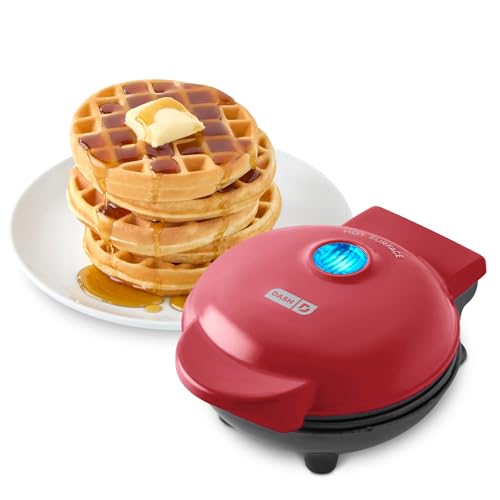
Whiskware Pancake Batter Mixer
Whiskware’s batter mixer combines mixing and controlled pouring in one bottle, which is handy when several students are sharing a waffle station. Ingredients go into the wide-opening container with the stainless steel BlenderBall, then the mixed batter dispenses through a silicone tip. The current model is dishwasher safe and the removable base doubles as a stand. It is most useful with pourable batters; very thick mixtures are less suited to bottle dispensing. The detachable ball, cap and base also mean a few extra pieces for the club equipment checklist.
KitchenAid Classic Mixing Bowls, Set of 5
A five-bowl set gives a waffle club room to split jobs rather than having every team wait for the same bowl. This KitchenAid set includes 1.5-, 2.5-, 3.5-, 4.5- and 5.5-quart bowls, with non-slip bases and pour spouts that are useful when students are mixing and transferring batter. The bowls nest for storage and are dishwasher safe. They are still a full five-piece set, so a small club with good existing kitchen equipment may not need another stack. For larger groups, the range of sizes is genuinely useful.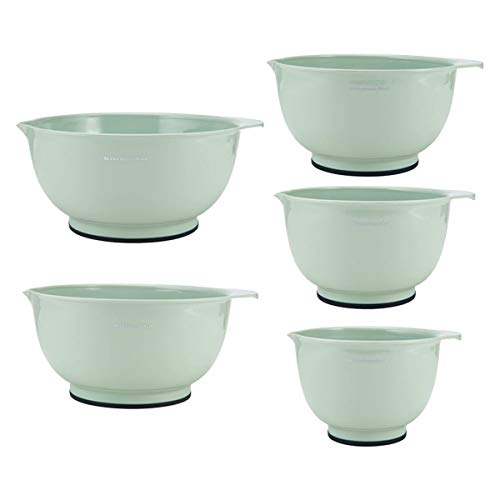
OXO Good Grips 11-Inch Balloon Whisk
A straightforward balloon whisk is still one of the most useful tools on the table. This 11-inch OXO model uses polished stainless steel wires and a soft non-slip handle, and it is dishwasher safe. The balloon shape works well for combining and aerating batters without adding another powered appliance to the room. It is a single whisk rather than a classroom set, so clubs running several mixing teams will either need more than one or should use existing school utensils alongside it. Simple equipment often earns its storage space.
OXO Good Grips 4-Cup Angled Measuring Cup
This 4-cup OXO measuring cup lets students read cup, ounce and milliliter markings from above rather than repeatedly lifting the cup to eye level. The Tritan Renew body is lightweight, with a non-slip handle and pouring spout, and the cup is top-rack dishwasher safe. Four cups is a useful capacity for measuring the liquid side of a waffle recipe or dividing ingredients between teams, but it is not a substitute for a large mixing bowl. The clear markings also make it useful when the club starts comparing recipe quantities.
Waffle making club resources
- The CDC Raw Flour and Dough guidance explains why uncooked flour and batter should not be tasted and covers safe handling and cleanup.
- CDC Preventing Food Poisoning sets out the Clean, Separate, Cook and Chill approach that can underpin a school food-preparation routine.
- The FDA guide to handling flour safely gives additional guidance on treating flour as a raw food and avoiding cross-contamination.
- FDA Food Allergies: What You Need to Know explains the major food allergens and US food-allergen labeling requirements.
- The CDC Food Allergies in School Toolkit is specifically aimed at schools and includes planning resources for reducing exposure and responding to allergic reactions.
- FCCLA STAR Events lists current competitive events, including food-related options such as Baking and Pastry and Food Innovations.
- The Minnesota 4-H Foods and Nutrition project shows how 4-H can extend food preparation into food science, safety and cultural learning; educators elsewhere can use it as a prompt to check local 4-H opportunities.
Click the button below to purchase all of the products in this Waffle Making Club guide from Amazon.
Buy from Amazon.comDisclosure: as an Amazon Associate, CoolerThanSchool.com earns from qualifying purchases.