
Looking to add a dash of wonder to your school’s extracurricular lineup? A Magic Club might be just the trick. This guide covers everything you’ll need to launch a successful club, from essential gear and practice routines to performances and opportunities for young magicians. You don’t need a stage full of trapdoors either. A deck of cards, a few dependable props and time to practise can go a surprisingly long way.
Equipment You’ll Need
Every magician needs tools, but you don’t need to break the bank. Start with basics like playing cards, foam or sponge balls for sleight-of-hand practice, coins, a close-up mat or piece of dark felt, and a few beginner props. A sturdy kit such as the Melissa & Doug Deluxe Magic Set gives younger beginners several self-contained tricks, while ordinary decks let students practise card technique without needing a different prop every week.
Don’t forget instructional resources. Mark Wilson’s Complete Course in Magic remains a broad reference for cards, coins, rope and stage-style effects, while the Society of American Magicians Youth program provides a structured route into the hobby. A whiteboard or projector helps demonstrate hand positions, and labeled storage bins keep props organized because nothing kills the magic faster than the vanishing thumb tip that was not supposed to vanish.
Pro tip: Assign a “magic keeper” student each week to manage gear. It builds responsibility and cuts down on missing items.
Suitable Locations
Flexibility is key. A standard classroom works for small groups, but if you’re hosting performances, grab the auditorium, library or drama room. Movable desks let students practise routines in pairs, while a clear front area gives everyone somewhere to test entrances, patter and audience management. Mirrors are useful for checking angles, although a school-approved phone or tablet recording can do the same job.
Outdoor spaces? Sure, but wind is the enemy of card tricks. If storage is tight, use a rolling cart to stash supplies. Good lighting matters more than a glamorous room. Also avoid anywhere small props can disappear into floor grates, deep carpeting or the mysterious ecosystem under auditorium seating.
Age Range
As a practical school recommendation, Magic Club works especially well from about grade 4 through middle school, when most students have the dexterity and patience for repeated practice. That is not an official age restriction. Beginner products vary: Melissa & Doug labels its Deluxe Magic Set for ages 8+, while S.A.M.Y. accepts youth members from ages 7 through 17.
Younger students can concentrate on self-working effects, simple cup-and-ball routines and prediction tricks. Older students may want more demanding card technique, coin work, scripting, stagecraft or mentalism-style effects. Mixed-age groups? Doable! Pair experienced students with beginners, but make sure mentors demonstrate rather than simply grabbing the cards and doing the trick themselves.
Who Will Enjoy This?
Got students who light up during talent shows or spend recess practising card flourishes? They’re your core crew. Magic Club can also suit quieter students because a rehearsed routine gives them a clear role, a script and a reason to speak to an audience without having to improvise every word.
It’s a fit for creative thinkers, puzzle lovers and students who enjoy figuring out how things work. Some routines invite discussion of probability, perception, optics, mechanics and misdirection, while others are really miniature pieces of theater. Students drawn to performance may also enjoy Cooler Than School’s Drama Club; secret-solvers and pattern hunters might prefer the Puzzle Club.
Things to Consider
The Good: Magic rewards patience, rehearsal, presentation and close observation. Most beginner routines use small reusable props, so a club can start cheaply and add specialist equipment later. Students can rotate between performer, audience member, coach and prop manager, keeping a larger group involved while one routine is being learned.
The Tricky: Props vanish. Set clear rules for borrowing, resetting and returning equipment, and agree which learning sources students may use on school devices. Keep routines age-appropriate and skip effects involving fire, blades, swallowing objects, dangerous restraints or anything else that turns a fun rehearsal into a call to the front office. Check school or district rules before filming or publishing student performances.
A 45-minute session could include:
- Warm-up and review of last week’s trick – 10 minutes
- New technique or routine – 15 minutes
- Practice in pairs with constructive feedback – 15 minutes
- Show-and-tell or one polished performance – 5 minutes
That is only a starting point. Some weeks need more rehearsal and less new material, especially before a showcase. It is usually better to perform three tricks cleanly than to own thirty props nobody can reset.
Further Pathways
For students who want to go beyond the school club, there are several genuine youth pathways. The Society of American Magicians now runs S.A.M.Y., formerly the Society of Young Magicians, for ages 7 through 17, with local and virtual assemblies. The International Brotherhood of Magicians also offers youth membership for ages 7 through 17, along with local Rings and youth activities.
Serious teen performers can look at the Academy of Magical Arts Junior Society in Hollywood. It is audition-based, with applicants generally eligible from ages 13 through 19 at audition and Junior Society participation continuing into age 20. These are optional next steps, not requirements. A school club can be successful with nothing more ambitious than a lunchtime show where the principal’s chosen card finally turns up in the right envelope.
A Magic Club isn’t just about tricks. Done well, it becomes a place to practise, perform, puzzle things out and recover gracefully when a card lands face-up on the floor. Keep the mood light, protect the secrets and give students enough rehearsal time to make the impossible look suspiciously easy.
Magic Club Equipment Recommendations
The products below are listed in a practical order for building a school Magic Club, from broad beginner equipment to cards and reference material.
National Geographic Kids Magic Kit with 45 Tricks
A strong all-round starter set for clubs working mainly with upper elementary and middle school beginners. The kit includes classic props such as cups and balls, a false thumb tip, a ball-and-vase effect, a coin case, a wand and a specialist card deck. Video instructions cover the routines and give students a consistent teaching source rather than sending everyone off to find a different tutorial. The current Amazon.com listing is the 45-trick set, marketed for ages 8-12.
Melissa & Doug Deluxe Magic Set
This solid-wood set is useful as a durable shared station rather than a box of disposable party tricks. It contains ten classic beginner effects, including the Disappearing Ball, Magic Coin Box, Secret Silks, Magic Number Prediction and Vanishing Coin. The hinged wooden box also keeps the pieces together and doubles as a small performance surface. Melissa & Doug recommends the set for ages 8+, making it a sensible choice for elementary and middle school groups that want tactile props with clear individual routines.
Bicycle Standard Rider Back Playing Cards 12-Pack
If the club is going to learn card magic, buying ordinary matching decks in bulk is more useful than relying on students to bring whatever happens to be in the kitchen drawer. This 12-pack contains standard poker-size Bicycle Rider Back decks, split between red and blue backs. They use Bicycle’s familiar Air Cushion finish and are suitable for shuffles, forces, controls, self-working tricks and basic cardistry. A dozen decks also means several pairs can practise at once without waiting for the club’s only usable pack.
Marvin’s Magic Fifty Greatest Card Tricks
This is a handy bridge between an ordinary deck and more specialist card gimmicks. The tin includes a deck, five packets of special card props and instructions for 50 routines. Marvin’s Magic rates it for ages 8+, so it can work as a supervised station for students who have mastered a few basic card handling skills and want effects that feel different from standard pick-a-card routines. The metal tin is also genuinely useful in a school club, where loose gimmicked cards have a remarkable talent for migrating into the wrong deck.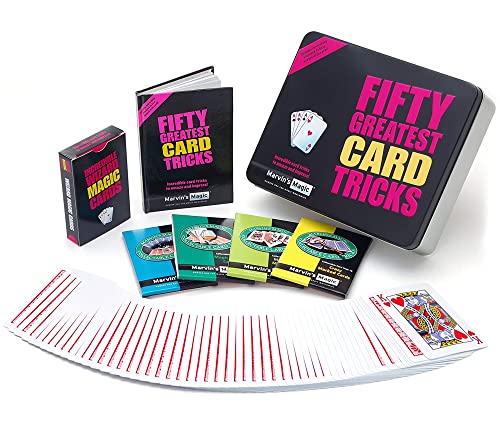
Mark Wilson’s Complete Course in Magic
A reference book gives the club something the latest trick kit often does not: a large bank of material that can be revisited as students improve. This revised Running Press paperback runs to more than 500 pages and covers cards, coins, rope, mental effects, stage magic and performance principles. It is better treated as a club library resource than a week-one textbook. Leaders can select suitable routines in advance, then use the diagrams and explanations to support practice without depending entirely on screens or scattered online tutorials.
Resources
- Society of American Magicians Youth – official S.A.M.Y. information for young magicians ages 7 through 17.
- S.A.M.Y. Assemblies – current local and virtual youth assembly listings.
- International Brotherhood of Magicians Youth Membership – youth membership information for ages 7 through 17.
- I.B.M. Contests – official information on I.B.M. competition opportunities, including its Youth Contest.
- I.B.M. Convention – convention information, including youth programming and the Lance Burton Teen Seminar.
- Academy of Magical Arts Junior Society – audition information and program details for serious young magicians.
- S.A.M. Stars of Tomorrow – performance opportunity information for young magicians ages 7 through 17.
Buying for a whole club? Add all five recommended items to an Amazon.com cart in one go, then adjust quantities before checkout to suit your group and budget.
Buy from Amazon.comAs an Amazon Associate CoolerThanSchool.com earns from qualifying purchases.